

Building the Future of Biodefense
Biothreat intelligence to deter and detect natural, accidental, deliberate and novel biological agents.

Recommendation: Organizations and employees should avoid all contact with the Potomac River and surrounding soil, including swimming, boating, wading, or fishing, while the sewage spill and repairs continue to reduce the risk of infection. Employees should practice good hand hygiene after potential exposure, prevent pets from drinking from the river, rely on safe drinking water, follow guidance from local authorities, and seek medical attention if gastrointestinal symptoms develop after possible contact.
Situation: The District of Columbia declared a local emergency and requested federal support after the Potomac Interceptor sewage break. The request seeks cost reimbursement, immediate federal aid for water monitoring and engineering, and long-term infrastructure improvements. According to media sources, the rupture of the 60-year-old Potomac Interceptor on 1/19 caused one of the largest sewage spills in US history, releasing millions of gallons of waste into the Potomac River. Repairs are expected to take months, with full replacement potentially taking up to 10 months. E. coli, Staphylococcus aureus, and antibiotic-resistant MRSA have been detected in the river, and officials advise residents to avoid contact with the water. DC Water built a bypass, but sporadic overflows continue. [Confidence: Very High]
Recommendation: Aedes aegypti is not widespread throughout mainland Chile, but it is established in Argentina. The presence of the invasive mosquitoes alone does not indicate that those diseases are circulating, as the mosquitoes must first bite an infected individual before transmitting a disease to others. Organizations in Chile and Argentina should reduce mosquito habitats by eliminating sources of standing water and applying insecticides to outdoor water storage containers. The temporary border closure may lead to travel delays.
Situation: The Los Libertadores Border Complex between Chile and Argentina will be temporarily closed from 2/19 to 2/20 after officials detected a suspected Aedes aegypti mosquito, a known carrier of dengue, chikungunya, Zika, and yellow fever. The closure allows for chemical treatment to control the vector. Transit will be suspended at the Guardia Vieja (Chile) and Uspallata (Argentina) border area. The crossing is expected to reopen at noon on 2/20. This follows a similar detection of the mosquito at Santiago airport in late January (see PHC alert 1/30). [Confidence: Very High]
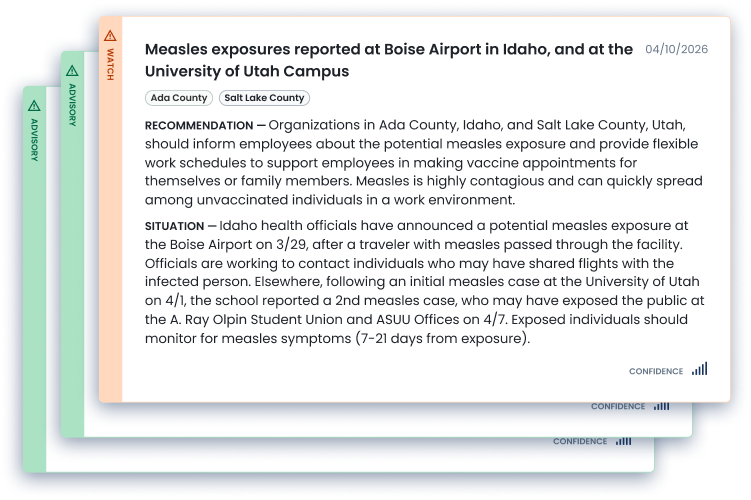
Recommendation: Organizations in Missouri should inform employees about the measles exposure location and provide flexible work schedules to support employees in making vaccine appointments for themselves or family members. Measles is highly contagious and can quickly spread among unvaccinated individuals in a work environment.
Situation: Missouri health officials confirmed a measles case in an out-of-state resident who may have exposed others on 2/7 while traveling through St. Louis Lambert International Airport, including Terminal 2 and baggage claim, and while riding Parking Spot shuttle #3 to the parking area. Exposed individuals should monitor for measles symptoms (7-21 days from exposure). [Confidence: Very High]
Recommendation: The average worker absenteeism for mumps is 5 days. Organizations in Maryland should provide flexible work schedules to support employees making vaccine appointments for themselves or family members.
Situation: Maryland Department of Health reported an uptick in mumps-related inquiries due to individuals with parotitis, which is inflammation of the salivary glands, presenting to acute care settings in late January. Media sources reported 14 mumps cases were recorded so far this year, mostly in adults in the Baltimore metropolitan area, which is higher than the 6 or fewer mumps cases typically reported in the state annually. [Confidence: Very High]
Recommendation: Organizations in the United States (US) should not eat or sell Rosabella brand moringa powder capsules while a Salmonella outbreak investigation is ongoing. Anyone with these products at their workplace or home should dispose of them. People at high risk of Salmonella-related complications may wish to avoid all products of the Rosabella brand moringa powder capsules while this investigation is ongoing.
Situation: The US CDC reported a new multistate outbreak of extensively drug-resistant Salmonella Newport linked to certain lots of Rosabella brand moringa powder capsules and distributed by Ambrosia Brands LLC. 52 lot codes with expiration dates in 2027 were affected and can be found via the source link. The product is available nationwide primarily online on the company's website (tryrosabella.com), Amazon, TikTok Shop, Shein, and eBay. 7 people from 7 states were infected so far, with 3 people hospitalized, but there are likely more unrecognized cases. The Salmonella strain in this outbreak is resistant to all first-line and alternative antibiotics commonly recommended for treatment. Onset of illnesses ranged from 11/7/25 to 1/8/26. No deaths have been reported. [Confidence: Very High]
Leverage operational biosurveillance to anticipate and assess biological risks, drive decision-making, and protect mission-critical operations.
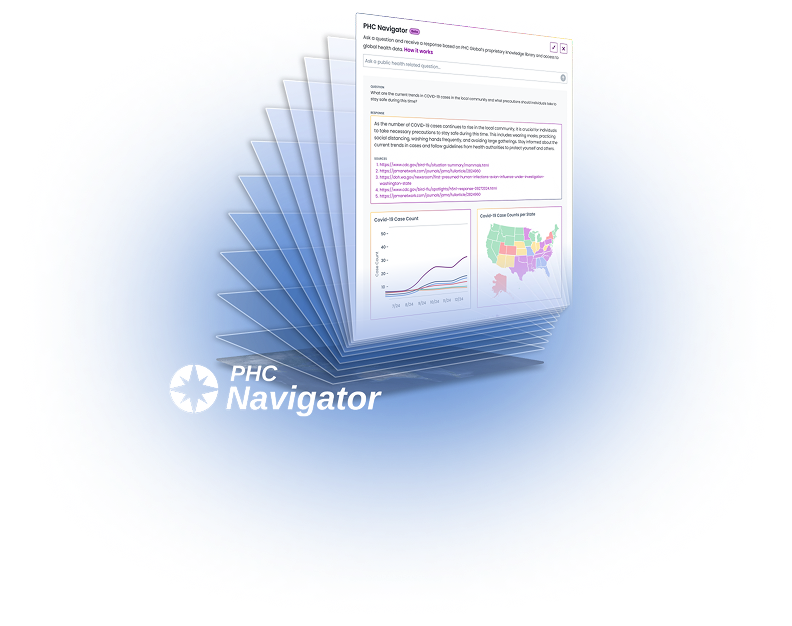
PHC Navigator is a biothreat intelligence engine built on expert-curated and proprietary data and models that provides actionable intelligence and insights

© 2025 PHC Global. All rights reserved.
We are excited to show you the PHC Pharos Platform in action!
Enter your contact information and we'll reach out to schedule a demo.